Business receipt or bank statement: why you need both
A bank statement shows a payment. A receipt explains the purchase and tax. Learn why Canadian business records need the purchase details, not just bank lines.
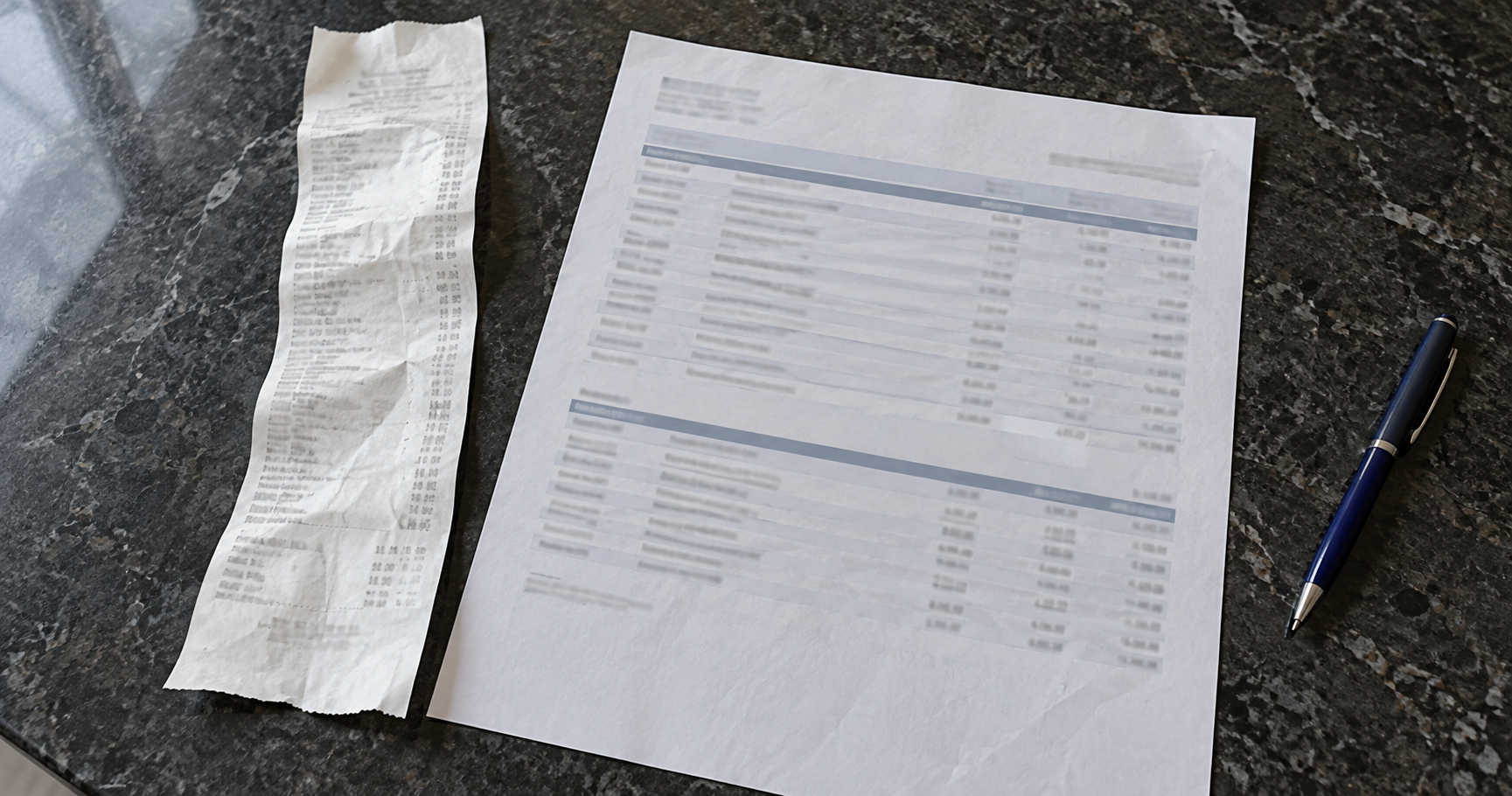
A bank statement and a receipt may show the same amount and date. That does not make them the same proof of a business expense. Each answers a different question. A folder of bank or credit-card statements does not replace the matching receipts or invoices in a Canadian business's records, even when every amount matches.
Two different kinds of evidence
A statement line confirms a payment: how much moved, when and to whom, using the name shown by the bank or card network. A receipt or invoice is a source document, meaning a record that supports the transaction. It lists what you bought, the quantity, the price and the tax. One shows that money moved. The other explains the purchase.
What a bank line does not show
A $42.17 coffee-shop charge confirms a payment happened. Was it fourteen coffees for a client meeting or a personal purchase on the same card? The bank line does not say. It also does not show how much of the $42.17 was tax. An itemized receipt supplies those purchase details. The statement may show the charge a day or two after the purchase. It may also combine a tip or another small purchase into one rounded amount. Check the receipt rather than assuming the bank line tells the whole story.
Why CRA expects the source document, not just the settlement line
The Canada Revenue Agency (CRA) explains general business record-keeping duties in Guide T4002. Businesses must keep supporting documents, not just proof that a payment cleared. A bank line lacks the details needed to check what was bought and why it relates to the business. Keep source documents accessible for the required period, rather than discarding them after payment. A reviewer checking the file months later needs those details too. If you save only statements, the gap may not become obvious until someone needs a missing receipt.
What Bookwits stores here, and what it does not
Bookwits documents can store and organize receipt images or files under the right client or company. Bookwits does not extract receipt data using optical character recognition (OCR), match bank-feed transactions or automatically choose expense categories. It stores the document; it does not read and classify it. It also cannot create or work out a missing receipt from a bank line.
Frequently asked questions
Can a bank or credit-card statement alone support an input tax credit claim?
Generally not. An input tax credit (ITC) recovers eligible goods and services tax or harmonized sales tax (GST/HST) paid on business purchases. You typically need the itemized receipt or invoice showing the tax charged, not just a bank line. Check CRA guidance for the current documents required for your claim.
How long should these source documents be kept?
CRA’s general guidance calls for keeping business records for a set number of years from the end of the relevant tax year. Check CRA’s current retention guidance directly for the exact period and any exceptions rather than relying on a figure repeated elsewhere.