Home Office Expenses: What Can a Self-Employed Person Claim?
Check whether your workspace qualifies, allow for personal use and follow a simple home-expense calculation with the business-income limit.
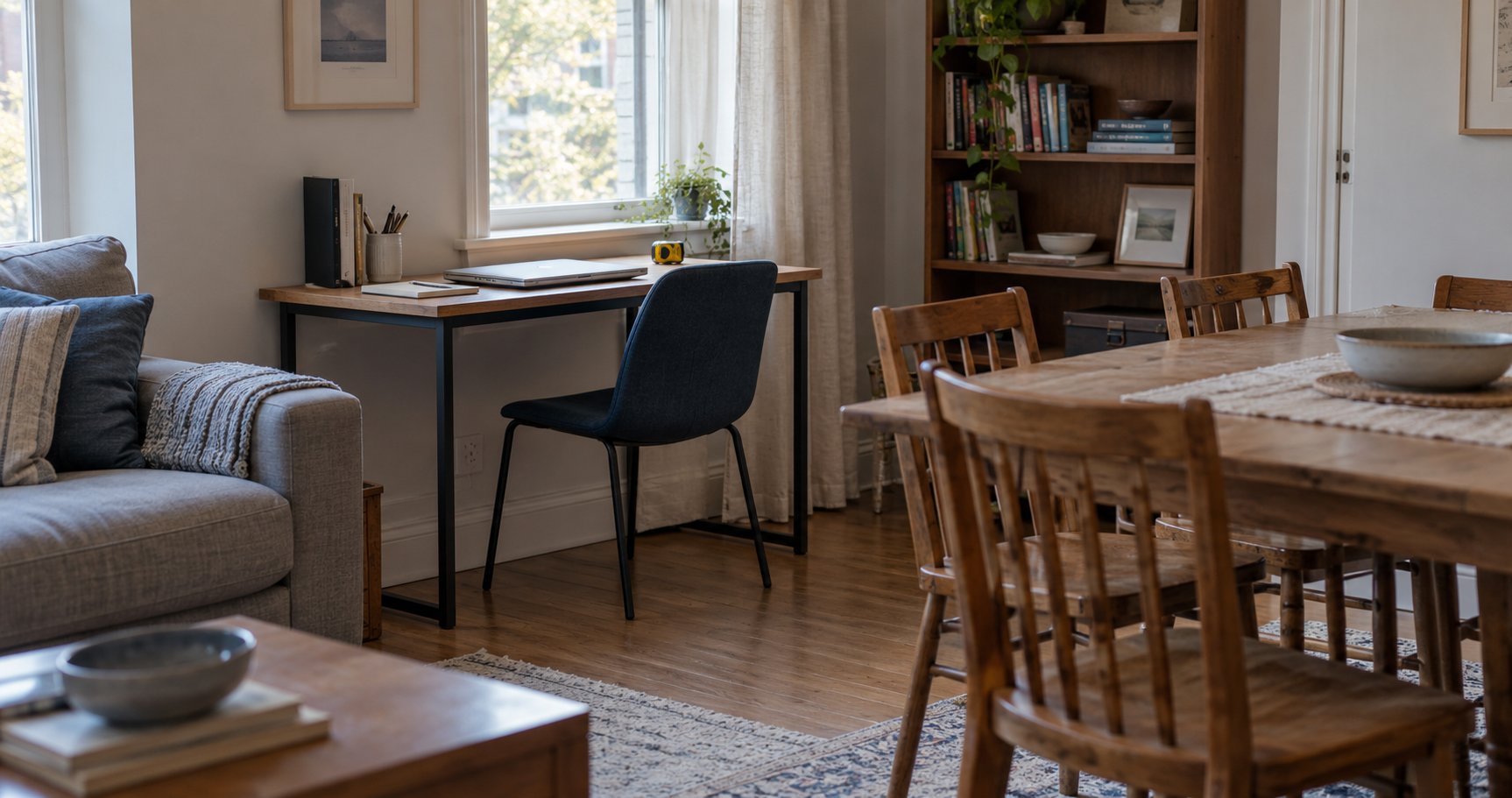
A desk occupying ten percent of a home does not automatically produce a ten-percent deduction from every household bill. First establish whether the workspace qualifies. Then choose a reasonable allocation for eligible costs, including a time adjustment when the space is shared personally.
This guide is for self-employed business-use-of-home expenses. It does not apply employee flat-rate policies or assume that an employee and a sole proprietor use the same claim rules. A home workspace can be convenient without meeting the relevant tax conditions.
Check eligibility before measuring the room
The workspace generally needs to meet one of two tests. It is your main place of business, or you use it only to earn business income and also use it regularly and continuously to meet clients, customers or patients. Check your actual situation against these tests. Owning a business, occasionally answering email at home or keeping a laptop in a bedroom does not prove that the space qualifies.
Document what work is done there, where the business is otherwise conducted, and whether the room is shared. In a borderline situation, obtain review before building a detailed claim on an unsupported assumption. More precise arithmetic does not repair failed eligibility.
The example below assumes a fictional self-employed translator's home is the principal place of business throughout the year. The room also serves personal purposes. This stated assumption is essential; the example does not suggest that a shared room automatically satisfies the exclusive-use alternative.
Measure area and shared time separately
Suppose the workspace measures 150 square feet within a 1,500-square-foot home, using a consistent, reasonable area basis. Its area share is 150 ÷ 1,500 = 10%. Retain the measurements and the explanation of which areas were included, not only the resulting percentage.
For this simplified full-year scenario, the shared room is available for personal use outside 35 business hours each week. Assume the documented pattern is consistent throughout the year and an hours-over-the-full-week allocation is reasonable for these facts. There are 168 hours in a week.
Combined share = 10% × 35 ÷ 168 = 2.083333…%. Keep the unrounded fraction for the calculation. Displaying 2.08% does not mean the underlying calculation should be rounded early.
Do not copy this percentage for every shared room. A room used only for work, a business running for part of the year, seasonal work or a changing schedule needs its own calculation and evidence. Do not use only your busiest week or leave out significant personal use.
A simple dated note can explain changes: the room became a guest room, business hours changed, or the business moved elsewhere. Update the allocation from the relevant facts rather than carrying an old percentage forward indefinitely. Keep the measurement method consistent enough that another person can understand why the annual result changed.
Select supported costs rather than every home payment
| Cost | Annual amount | Review point |
|---|---|---|
| Rent | $10,800 | Keep lease and payment support |
| Utilities | $2,400 | Confirm the period and avoid duplicate inclusion |
| Home insurance | $1,200 | Separate any treatment already reflected elsewhere |
| Illustrative eligible cost base | $14,400 | Assumed reviewed for this example |
Applying the unrounded combined share gives $14,400 × 10% × 35 ÷ 168 = $300. This is the illustrative allocated amount before the business-income limitation. The household pays $14,400; the example does not treat the whole amount as a business expense.
For an owner rather than a renter, potential categories can include appropriate portions of utilities, insurance, maintenance, property taxes, and mortgage interest under the applicable rules. Mortgage principal is not an expense merely because it is paid monthly. Review financing purpose and the category-specific requirements.
Costs relating only to a particular area may need a different treatment from whole-home costs. A personal-room renovation should not enter the allocation simply because it occurred in the same house. Capital improvements also differ from ordinary maintenance. Keep invoices and explain the relationship to the business workspace.
Apply the income limitation after the allocation
Business-use-of-home expenses cannot create or increase a business loss. In a second assumption for the fictional example, only $180 of relevant business income is available before this deduction. Of the $300 allocated amount, the current claim is limited to $180, leaving $120 potentially available to carry forward under the applicable conditions.
Track the unused amount separately. Each year, show what was left from last year, the new eligible amount, what you used and what remains for later. You cannot automatically deduct the balance next year. The rules for eligibility and use by the same business must still be met.
Check that expenses have not already been claimed in another category, by another claimant, or through a reimbursement. Separate business supplies and equipment from the home-cost allocation so the same invoice does not appear twice.
Preserve the decisions that need review
Capital cost allowance (CCA) is a tax deduction for eligible long-term property. Claiming it on your home can affect the principal-residence tax treatment when you sell. It can also trigger recapture, where past deductions are added back to income, or other consequences. Do not claim it just to increase this year's deduction. Speak with an accountant first.
- Keep the eligibility explanation and any professional review.
- Retain area measurements and evidence of shared-use hours.
- Save bills, lease or financing support, and cost-category decisions.
- Recheck use patterns and income limits each year.
- Carry forward unused eligible amounts with a clear audit trail.
Bookwits can coordinate the document checklist and review questions. It does not measure the home or calculate a tax deduction. A useful package makes the facts and assumptions visible so that the preparer can assess them, rather than receiving an unexplained percentage.
Frequently asked questions
Does a home desk automatically qualify?
No. The applicable workspace eligibility test must be met. Convenience or occasional home work alone does not establish a self-employed business-use-of-home deduction.
Should a shared room use only its area percentage?
Not necessarily. Personal use generally requires a reasonable time adjustment as well. Document the actual pattern instead of borrowing the example’s hours.
Can these expenses create a business loss?
No. The current deduction is limited by the applicable business income. Unused eligible amounts can generally be carried forward subject to the relevant conditions.
Should I always claim CCA on the home?
No. Ask an accountant how it could affect the tax treatment of your principal residence and whether past deductions could be added back to income when you sell. Consider those later effects before deciding.